The Best Brand Book Is Not a Design File. It Is an Operating System.
A strong brand book does not just define visuals. It reduces operational drag by turning positioning, voice, governance, and brand decisions into a system teams can actually run.
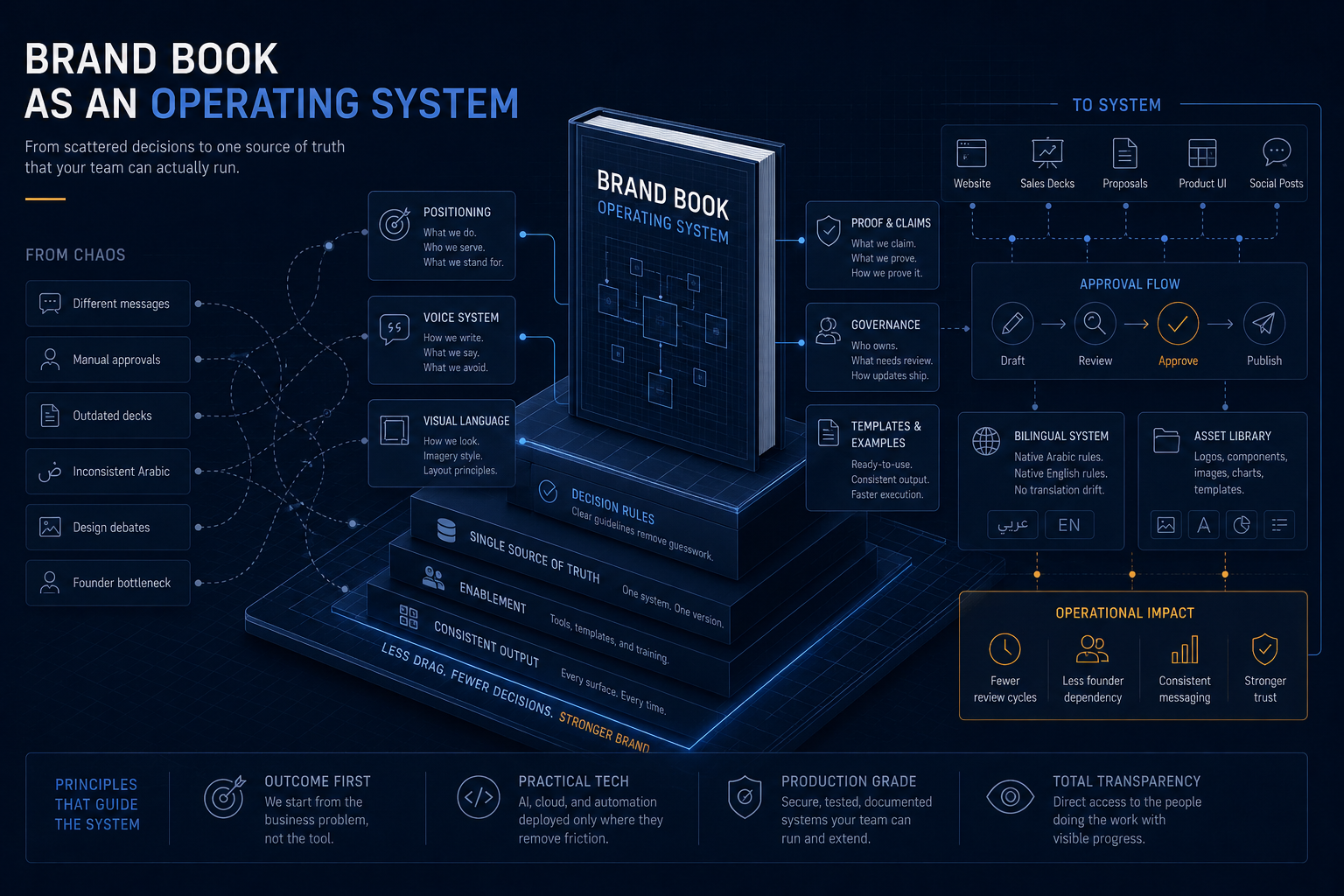
The Best Brand Book Is Not a Design File. It Is an Operating System.
A weak brand book makes the company look organized.
A strong brand book makes the company operate with less guessing.
That is the difference most teams miss.
Most companies treat the brand book as a visual reference. Logo rules. Color codes. Typography. A few mockups. Some tone-of-voice statements.
Useful, but incomplete.
The real job of a brand book is not to preserve design taste. It is to reduce operational drag across every place the brand shows up.
Sales decks. Website pages. Product screens. Founder posts. Proposals. Internal documentation. Arabic copy. English copy.
Every one of these surfaces forces someone to make a decision.
What do we say?
What do we avoid?
Which proof do we use?
Who approves this?
What breaks the brand?
If the brand book does not answer these questions clearly, the team answers them manually every time.
That is where most brand systems fail.
Not because the logo is weak.
Because the operating rules are missing.
Key Highlights
- A brand book should function as an operating manual, not a decorative PDF.
- The best brand books define decisions, not just visuals.
- Positioning, voice, proof, and governance matter more than mockups.
- Bilingual brands need native Arabic rules, not translated afterthoughts.
- The test is simple: can the team ship consistent work without the founder in the room?
Most Brand Books Are Built for Presentation, Not Operation
Most brand books are optimized for approval meetings.
They show polished layouts, nice typography, and logo applications on business cards or laptops.
But companies do not run on presentation slides.
They run on repeated decisions.
A sales lead assembles a proposal.
A founder updates the homepage.
A designer creates a landing page.
A product team ships new UI copy.
A writer publishes an Arabic post.
If the brand book only explains what the brand looks like, the team still has to guess how the brand behaves.
That is not a system.
That is a gallery.
Start With Positioning Before Visual Identity
The first layer of a brand book is not the logo.
It is positioning.
The document must define what the company fundamentally does before it defines color palettes or typography systems.
For Tasawom, the positioning is simple:
We turn messy operations into reliable systems.
That sentence is not decoration. It is a decision filter.
It tells the team what to write about, what visuals fit, what offers belong under the brand, and what to reject.
Weak positioning sounds like this:
“We build innovative digital solutions for modern businesses.”
Strong positioning sounds like this:
“We replace spreadsheet-driven workflows, inbox chasing, and manual coordination with internal systems teams can actually run.”
The second version creates boundaries.
Boundaries reduce drift.
Define What the Brand Is Not
A strong brand book defines exclusions clearly.
Otherwise every new asset becomes a debate.
For Tasawom, that means:
- Not a generic dev shop.
- Not a branding agency.
- Not an AI gimmick company.
- Not a team that sells dashboards without operational logic.
- Not a company that builds before understanding the workflow.
Those exclusions matter because they stop the brand from collapsing into generic B2B language.
They also make decisions faster.
A team member should know immediately that glowing AI imagery, hype-heavy copy, or vague “digital transformation” messaging does not belong.
The Voice Section Must Show Sentence Behavior
Most voice sections fail because they stay abstract.
They say the brand is “clear,” “bold,” “professional,” or “innovative.”
That is not executable.
Writers need sentence behavior, not adjectives.
For Tasawom, the voice should sound like a senior engineer explaining business impact.
Weak:
“Our AI workflow automation empowers organizations to improve efficiency.”
Better:
“AI is useful only when it removes a real step from the workflow.”
Weak:
“We provide scalable solutions for modern enterprises.”
Better:
“If the workflow is unclear, software only makes the mess faster.”
The difference is mechanism.
A usable brand book should include before-and-after examples across:
- Website copy
- Product UI
- Proposals
- Thought leadership
- Arabic writing
- Error states
- Internal documentation
Without examples, every writer invents their own interpretation.
Words to Avoid Are Not Cosmetic
Banned words are not about style preferences.
They exist because vague language hides weak thinking.
Words like:
- synergy
- revolutionize
- empower
- unlock
- scalable solution
- leverage
usually replace operational detail with abstraction.
A good brand book explains why those words fail.
Then it replaces them with concrete mechanisms.
Instead of saying:
“We streamline operations.”
Explain what changed:
- The approval moved into a tracked workflow.
- The owner became visible.
- Escalation became automatic.
- The system stopped relying on manual updates.
Specificity builds trust faster than adjectives.
Real Brand Failure Usually Looks Operational
The biggest problems are rarely visual.
They are operational.
We have seen companies with three different positioning statements live at the same time across proposals, investor material, and the homepage.
We have seen teams spend days debating Arabic headline tone because the guide only defined English voice.
We have seen founders become permanent approval bottlenecks because nobody defined what the team could publish independently.
These are not branding problems in the traditional sense.
They are workflow failures.
Most brand books fail for the same reason internal software fails:
Nobody defined ownership after launch.
Visual Identity Should Reflect How the Company Thinks
The visual system should reinforce the operating logic of the company.
For Tasawom, that means:
- system diagrams
- blueprint geometry
- workflow maps
- internal tool screenshots
- structured layouts
- dark operational surfaces
Not:
- stock business teams
- glowing AI brains
- random tech patterns
- startup clichés
The imagery should feel like a peek inside a working system.
Not a mood board.
A workflow diagram is useful because it communicates structure.
A screenshot is useful because it proves the work exists in production.
The visuals should support the argument, not distract from it.
Bilingual Brands Need Native Rules
Arabic cannot be treated as a translation layer.
That produces copy that is technically correct but strategically weak.
A bilingual brand needs separate rules for:
- typography
- layout direction
- terminology
- tone
- CTA structure
- sentence rhythm
For Tasawom, Arabic should sound direct, institutional, and native.
Not literary.
Not inflated.
Not translated word-for-word from English.
This matters more than most companies realize.
A bilingual system without clear language rules creates brand drift faster than inconsistent colors ever will.
Governance Is Part of the Brand System
Most brand books ignore governance completely.
That is a mistake.
The document should define:
- who owns the brand
- what requires approval
- what templates are locked
- where assets live
- how updates ship
- which claims require proof review
Otherwise the brand slowly fragments.
Old decks circulate.
Outdated messaging survives.
Different teams invent different narratives.
The problem compounds quietly.
Until the company sounds like three separate businesses.
The Real Test
A strong brand book passes one operational test:
Can a competent team member create a correct asset without asking the founder to explain the company again?
If the answer is no, the system is incomplete.
A proper brand book should reduce:
- founder dependence
- review cycles
- inconsistent messaging
- translation drift
- design debates
- operational confusion
That is the real value.
Not the number of pages.
Not the presentation quality.
Operational clarity.
Service-Ready Takeaways
The best brand books behave like internal systems.
They contain:
- positioning
- voice rules
- visual constraints
- proof boundaries
- bilingual standards
- governance
- reusable examples
- ownership logic
The weak version says:
“Here is how the brand looks.”
The strong version says:
“Here is how the brand makes decisions.”
That is the difference between a document and a system.
If one workflow in your company still runs through spreadsheets, inboxes, and manual chasing, start there.
Book a Free Workflow Teardown.